
Dome CCTV cameras.
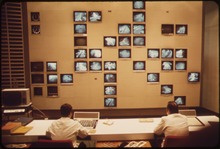
In industrial plants, CCTV equipment may be used to observe parts of a process from a central control room, for example when the environment is not suitable for humans. CCTV systems may operate continuously or only as required to monitor a particular event. A more advanced form of CCTV, utilizing digital video recorders[3] (DVRs), provides recording for possibly many years, with a variety of quality and performance options and extra features (such as motion detection and email alerts). More recently, decentralized IP cameras, some equipped with megapixel sensors, support recording directly to network-attached storage devices, or internal flash for completely stand-alone operation. Surveillance of the public using CCTV is particularly common in many areas around the world. In recent years, the use of body worn video cameras has been introduced as a new form of surveillance.
History
Closed circuit TV in Munich, 1973 photo

Sign warning that premises are watched by CCTV cameras.
In the U.S. the first commercial closed-circuit television system became available in 1949, called Vericon. Very little is known about Vericon except it was advertised as not requiring a government permit.[8]
Technology
The earliest systems required constant monitoring because there was no way to record and store the information. Recording systems were introduced later, when primitive reel-to-reel media was used to preserve the data. These systems required magnetic tapes to be changed manually. It was a time consuming, expensive and unreliable process; the operator had to manually thread the tape from the tape reel through the recorder onto an empty take-up reel. Due to these short-comings, video surveillance was rare. Only when VCR technology became available in the 1970s, making it easier to record and erase information, did video surveillance start to become more common.[9]During the 1990s, digital multiplexing was developed, which allowed several cameras to record at once, as well as time lapse and motion-only recording. This increased the use of CCTV[10] and increased the savings of time and money.
Recently CCTV has been transformed by the shift towards internet-based products and systems, and other technological developments.[citation needed]
Application
In September 1968, Olean, New York was the first city in the United States to install video cameras along its main business street in an effort to fight crime.[11] Another early appearance was in 1973 in Times Square in New York City.[12] The NYPD installed it in order to deter crime that was occurring in the area; however, crime rates did not appear to drop much due to the cameras.[12] Nevertheless, during the 1980s video surveillance began to spread across the country specifically targeting public areas.[10] It was seen as a cheaper way to deter crime compared to increasing the size of the police departments.[12] Some businesses as well, especially those that were prone to theft, began to use video surveillance.[12] From the mid-1990s on, police departments across the country installed an increasing number of cameras in various public spaces including housing projects, schools and public parks departments.[12] CCTV later became common in banks and stores to discourage theft, by recording evidence of criminal activity. In 1998, 3,000 CCTV systems were in use in New York City.[13]Experiments in the UK during the 1970s and 1980s, including outdoor CCTV in Bournemouth in 1985, led to several larger trial programs later that decade. The first use by local government was in King's Lynn, Norfolk, in 1987.[14] These were deemed successful in the government report "CCTV: Looking Out For You", issued by the Home Office in 1994, and paved the way for an increase in the number of CCTV systems installed. Today, systems cover most town and city centres, and many stations, car-parks and estates.
Uses
Crime prevention

The two year-old James Bulger being led away by his killers, recorded on shopping centre CCTV in 1993. This narrow-bandwidth television system had a low frame rate.
The analysis found that:
- Surveillance systems were most effective in parking lots, where their use resulted in a 51% decrease in crime;
- Public transportation areas saw a 23% decrease in crimes;
- Systems in public settings were the least effective, with just a 7% decrease in crimes overall. When sorted by country, however, systems in the United Kingdom accounted for the majority of the decrease; the drop in other areas was insignificant.[15]

Closed-circuit video cameras in the Navy Yard complex caught gunman Aaron Alexis during his shooting rampage.
A more open question is whether most CCTV is cost-effective. While low-quality domestic kits are cheap the professional installation and maintenance of high definition CCTV is expensive.[24] Gill and Spriggs did a Cost-effectiveness analysis (CEA) of CCTV in crime prevention that showed little monetary saving with the installation of CCTV as most of the crimes prevented resulted in little monetary loss.[17] Critics however noted that benefits of non-monetary value cannot be captured in a traditional Cost Effectiveness Analysis and were omitted from their study.[17] A 2008 Report by UK Police Chiefs concluded that only 3% of crimes were solved by CCTV.[25] In London, a Metropolitan Police report showed that in 2008 only one crime was solved per 1000 cameras.[26] In some cases CCTV cameras have become a target of attacks themselves.[27]
Cities such as Manchester in the UK are using DVR-based technology to improve accessibility for crime prevention.[28]
In October 2009, an "Internet Eyes" website was announced which would pay members of the public to view CCTV camera images from their homes and report any crimes they witnessed. The site aimed to add "more eyes" to cameras which might be insufficiently monitored. Civil liberties campaigners criticized the idea as "a distasteful and a worrying development".[29]
In 2013 Oaxaca hired deaf police officers to lip read conversations to uncover criminal conspiracies.[30]
Industrial processes
Industrial processes that take place under conditions dangerous for humans are today often supervised by CCTV. These are mainly processes in the chemical industry, the interior of reactors or facilities for manufacture of nuclear fuel. Special cameras for some of these purposes include line-scan cameras and thermographic cameras which allow operators to measure the temperature of the processes. The usage of CCTV in such processes is sometimes required by law.[specify]Traffic monitoring
Main article: Traffic camera
Many cities and motorway networks have extensive traffic-monitoring systems, using closed-circuit television to detect congestion and notice accidents.[31] Many of these cameras however, are owned by private companies and transmit data to drivers' GPS systems.The UK Highways Agency has a publicly owned CCTV network of over 1,200 cameras covering the British motorway and trunk road network. These cameras are primarily used to monitor traffic conditions and are not used as speed cameras. With the addition of fixed cameras for the Active Traffic Management system, the number of cameras on the Highways Agency's CCTV network is likely to increase significantly over the next few years.[citation needed]
The London congestion charge is enforced by cameras positioned at the boundaries of and inside the congestion charge zone, which automatically read the licence plates of cars. If the driver does not pay the charge then a fine will be imposed. Similar systems are being developed as a means of locating cars reported stolen.[citation needed]
Other surveillance cameras serve as traffic enforcement cameras.[citation needed]
Transport safety

Digital Video Recorder for Public Transport
Operators of an amusement park ride may use a CCTV system to observe that people are not endangered by starting the ride. A CCTV camera and dashboard monitor can make reversing a vehicle safer, if it allows the driver to observe objects or people not otherwise visible.[citation needed]
Control of retail
Someas software integrate with CCTV to monitor the actions of workers in retail environments. Every action is recorded as an information block with subtitles that explain the performed operation. This helps to track the actions of workers, especially when they are making critical financial transactions, such as correcting or cancelling of a sale, withdrawing money or altering personal information.[citation needed]Actions which an employer may wish to monitor could include:[citation needed]
- Scanning of goods, selection of goods, introduction of price and quantity;
- Input and output of operators in the system when entering passwords;
- Deleting operations and modifying existing documents;
- Implementation of certain operations, such as financial statements or operations with cash;
- Moving goods, revaluation scrapping and counting;
- Control in the kitchen of fast food restaurants;
- Change of settings, reports and other official functions.
Use in schools
In the United States, closed-circuit television is used for school security to monitor visitors, track unacceptable student behavior and maintain a record of evidence in the event of a crime. There are some restrictions on installation, cameras may not be used in an area where there is a "reasonable expectation of privacy". Examples of these are bathrooms, gym locker areas and private offices (unless consent by the office owner is given). Сameras are generally acceptable in hallways, parking lots, front offices where students, employees, and parents come and go, gymnasiums, cafeterias, supply rooms and classrooms. The use of cameras in classrooms is often debated by teachers who want cameras for protection and teachers who do not.[32]Criminal use
Criminals may use surveillance cameras to monitor the public. For example, a hidden camera at an ATM can capture people's PINs as they are entered, without their knowledge. The devices are small enough not to be noticed, and are placed where they can monitor the keypad of the machine as people enter their PINs. Images may be transmitted wirelessly to the criminal.[33]Prevalence


Surveillance camera mounted on the walls of Rosenbad, one of the
Swedish's government buildings in central Stockholm, which houses the
Prime Minister's office. One of the parliament's (Riksdagen) building
can be seen in the background.

A surveillance camera, aimed at a public street (Kungsgatan) in Stockholm, Sweden, mounted on top of the pole.
In Latin America, the CCTV market is growing rapidly with the increase of property crime.[37]
An article published in CCTV Image magazine estimated the number of cameras in the United Kingdom was 1.85 million in 2011. The estimate was based on extrapolating from a comprehensive survey of public and private cameras within the Cheshire Constabulary jurisdiction.[38] This works out as an average of one camera for every 32 people in the UK, although the density of cameras varies greatly from place to place. The Cheshire report also claims that the average person on a typical day would be seen by 70 CCTV cameras.
The Cheshire figure is regarded as more dependable than a previous study by Michael McCahill and Clive Norris of UrbanEye published in 2002.[39] Based on a small sample in Putney High Street, McCahill and Norris estimated the number of surveillance cameras in private premises in London at around 500,000 and the total number of cameras in the UK at around 4,200,000. According to their estimate the UK has one camera for every 14 people. Although it has been acknowledged for several years that the methodology behind this figure is flawed,[40] it has been widely quoted.
The CCTV User Group estimated that were are around 1.5 million CCTV cameras in city centres, stations, airports, and major retail areas in the UK.[41] This figure does not include the smaller surveillance systems such as those that may be found in local corner shops and is therefore broadly in line with the Cheshire report.
Research conducted by the Scottish Centre for Crime and Justice Research and based on a survey of all Scottish local authorities, identified that there are over 2,200 public space CCTV cameras in Scotland.[42]
Privacy

A mobile closed-circuit TV van monitoring a street market
In the United State of America Video Surveillance is readily available upon a judges writ.
- Video Surveillance—Closed Circuit Television—Department of Justice Approval Required When There Is A Reasonable Expectation of Privacy.[44]
Questions are also raised about illegal access to CCTV recordings. The Data Protection Act 1998 in the United Kingdom led to legal restrictions on the uses of CCTV recordings, and also mandated their registration with the Data Protection Agency. In 2004, the successor to the Data Protection Agency, the Information Commissioner's Office clarified that this required registration of all CCTV systems with the Commissioner, and prompt deletion of archived recordings. However, subsequent case law (Durant vs. FSA) limited the scope of the protection provided by this law, and not all CCTV systems are currently regulated.[47] However, private sector personnel in the UK who operate or monitor CCTV devices or systems are considered security guards and have been made subject to state licensing.
A 2007 report by the UK Information Commissioner's Office, highlighted the need for the public to be made more aware of the "creeping encroachment" into their civil liberties created by the growing use of surveillance.[48][49] In the same year, the UK watchdog CameraWatch claimed that the majority of CCTV cameras in the UK are operated illegally or are in breach of privacy guidelines.[50] In response, the Information Commissioner's Office denied the claim adding that any reported abuses of the Data Protection Act are swiftly investigated.[50]
The UK Home Office published a code of practice in 2013 for the use of surveillance cameras by government and local authorities. The aim of the code is to help ensure their use is "characterised as surveillance by consent, and such consent on the part of the community must be informed consent and not assumed by a system operator. Surveillance by consent should be regarded as analogous to policing by consent."[51]
In Canada, the use of video surveillance has grown very rapidly. In Ontario, both the municipal and provincial versions of the Freedom of Information and Protection of Privacy Act outline very specific guidelines that control how images and information can be gathered by this method and or released.[52]
Technological developments

Surveillance camera at London Heathrow Airport with a wiper for clear images during rain
Computer controlled analytics and identification
Computer controlled cameras can identify, track, and categorize objects in their field of view.[citation needed]Video Content Analysis (VCA) is the capability of automatically analyzing video to detect and determine temporal events not based on a single image. As such, it can be seen as the automated equivalent of the biological visual cortex.
A system using VCA can recognize changes in the environment and even identify and compare objects in the database using size, speed, and sometimes colour. The camera’s actions can be programmed based on what it is “seeing”. For example; an alarm can be issued if an object has moved in a certain area, or if a painting is missing from a wall, or if a smoke or fire is detected, or if running people are detected, or if fallen people are detected and if someone has spray painted the lens, as well as video loss, lens cover, defocuss and other so called camera tampering events.[citation needed]
VCA analytics can also be used to detect unusual patterns in an environment. The system can be set to detect anomalies in a crowd, for instance a person moving in the opposite direction in airports where passengers are only supposed to walk in one direction out of a plane or in a subway where people are not supposed to exit through the entrances.[53]
VCA can track people on a map by calculating their position from the images. It is then possible to link many cameras and track a person through an entire building or area. This can allow a person to be followed without having to analyze many hours of film. Currently the cameras have difficulty identifying individuals from video alone, but if connected to a key-card system, identities can be established and displayed as a tag over their heads on the video.[citation needed]
There is also a significant difference in where the VCA technology is placed, either the data is being processed within the cameras (on the edge) or by a centralized server. Both technologies have their pros and cons.[54]
Facial recognition system Is a computer application for automatically identifying or verifying a person from a digital image or a video frame from a video source. One of the ways to do this is by comparing selected facial features from the image and a facial database.[citation needed]
The combination of CCTV and facial recognition has been tried as a form of mass surveillance, but has been ineffective because of the low discriminating power of facial recognition technology and the very high number of false positives generated. This type of system has been proposed to compare faces at airports and seaports with those of suspected terrorists or other undesirable entrants.[citation needed]

Eye-in-the-sky surveillance dome camera watching from a high steel pole
To many, the development of CCTV in public areas, linked to computer databases of people's pictures and identity, presents a serious breach of civil liberties. Conservative critics fear the possibility that one would no longer have anonymity in public places.[55] Demonstrations or assemblies in public places could be affected as the state would be able to collate lists of those leading them, taking part, or even just talking with protesters in the street.
Comparatively harmless are people counter systems. They use CCTV equipment as front end eyes of devices which perform shape recognition technology in order to identify objects as human beings and count people passing pre-defined areas.
Retention, storage and preservation
Most CCTV systems record and store digital video and images to a Digital Video Recorder or in the case of IP cameras directly to a server, either on-site or offsite.[citation needed]The amount of data stored and the retention period of the video or pictures are subject to compression ratios, images stored per second, image size and duration of image retention before being overwritten.[56]
Recordings are usually kept for a preset amount of time and then automatically archived, overwritten or deleted. Videos are kept in order to allow retrieval and review in the event a crime was committed or the information needs to be studied for any number of reasons.[citation needed]
Many digital video recorders (DVR) for closed-circuit television (CCTV) store their contents in a proprietary file format, and export the video files to an optical storage media such as digital versatile disc. When the DVR is damaged before export, a proprietary format hinders recovery of video files and timestamps from a DVR hard disk in a forensically sound manner.
Closed-circuit digital photography (CCDP)
See also: Closed-circuit television camera
Closed-circuit digital photography (CCDP) is more suited for
capturing and saving recorded high-resolution photographs, whereas
closed-circuit television (CCTV) is more suitable for live-monitoring
purposes.[citation needed]However, an important feature of some CCTV systems is the ability to take high resolution images of the camera scene, e.g. on a time lapse or motion-detection basis. Images taken with a digital still camera often have higher resolution than those taken with some video cameras. Increasingly, low-cost high-resolution digital still cameras can also be used for CCTV purposes.[citation needed]
Images may be monitored remotely when the computer is connected to a network.[citation needed]
IP cameras
Main article: IP camera

Easy Connect Wireless IP camera
Networking CCTV cameras
The city of Chicago operates a networked video surveillance system which combines CCTV video feeds of government agencies with those of the private sector, installed in city buses, businesses, public schools, subway stations, housing projects etc. Even home owners are able to contribute footage. It is estimated to incorporate the video feeds of a total of 15,000 cameras.[citation needed]The system is used by Chicago's Office of Emergency Management in case of an emergency call: it detects the caller's location and instantly displays the real-time video feed of the nearest security camera to the operator, not requiring any user intervention. While the system is far too vast to allow complete real-time monitoring, it stores the video data for later usage in order to provide possible evidence in criminal cases.[58]
London also has a network of CCTV systems that allows multiple authorities to view and control CCTV cameras in real time. The system allows authorities including the Metropolitan Police Service, Transport for London and a number of London boroughs to share CCTV images between them. It uses a network protocol called Television Network Protocol to allow access to many more cameras than each individual system owner could afford to run and maintain.[citation needed]
The Glynn County Police Department uses a wireless mesh-networked system of portable battery-powered tripods for live megapixel video surveillance and central monitoring of tactical police situations. The systems can be used either on a stand-alone basis with secure communications to nearby police laptops, or within a larger mesh system with multiple tripods feeding video back to the command vehicle via wireless, and to police headquarters via 3G.[citation needed]
Integrated systems

An integrated systems unit.
Wireless security cameras
Main article: Wireless security camera
Many consumers are turning to wireless security cameras for home surveillance.[citation needed]
Wireless cameras do not require a video cable for video/audio
transmission, simply a cable for power. Wireless cameras are also easy
and inexpensive to install.[citation needed]
Previous generations of wireless security cameras relied on analog
technology; modern wireless cameras use digital technology which
delivers crisper audio, sharper video, and a secure and
interference-free signal.[60]
CCTV camera vandalism
Unless physically protected, CCTV cameras have been found to be vulnerable against a variety of (mostly illegal) tactics:[citation needed]- Some people will deliberately destroy cameras. Some cameras can come with dust-tight, pressurized, explosion proof, and bullet-resistant housings.
- Spraying substances over the lens can make the image too blurry to view.
- Lasers can blind or damage them. However, since most lasers are monochromatic, color filters can reduce the effect of laser pointers. However, filters will also impair image quality and overall light sensitivity of cameras (see laser safety article for details on issues with filters). Also, complete protection from infrared, red, green, blue and UV lasers would require use of completely black filterS rendering the camera useless.
